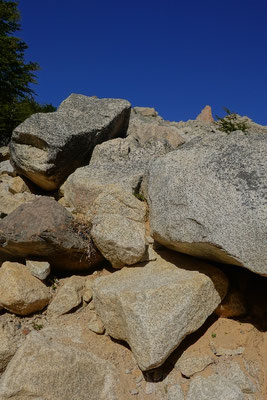
On the W Trek in Patagonia: Break an Arm! A Story about Willpower.

March 28, 2026

The ranger, who speaks only Spanish, holds the carpet knife to my husband’s arm and implies that we could simply cut it off. Meanwhile, her co-worker folds a sturdy
cardboard box into shape. Then we all laugh. We are in the middle of the Andes, at world's end, no cell service—trekking for five days with a tent and backpacks on the W
Trek in Torres del Paine National Park in Patagonia. Now also available with a broken arm. Yes, the same one that was fractured six months ago in Canada. We sure know
how to break things, and how to still hike.
The W Trek is one of the great long-distance hiking trails in Patagonia. 43 miles, a total elevation gain of about 10000 feet, gale-force winds blowing sideways,
granite towers, turquoise lakes, red flowers, glacier peaks, icebergs, gnarly forests, and total despair always just a breath away from total enchantment.
This is the story about how we braved accidents, black eyes, kidney stones, storms, heat, foxes at night, and a monumental climb up a scree slope. How we hiked through one of the
most beautiful landscapes in the world and were lucky enough to live in it for a few days. How this experience pushed us to our limits and beyond—and we didn’t
come back as the same people.
Fox encounter at night at Camp

My feet hurt sooo much—but wow, what a view of the Grey Glacier, so close with its bright blue terminus that looks like shark teeth! My shoulders are sooo sore—but wow, what
beautiful red flowers there had been right on the slope leading down to that milky-green lake! I’m sooo tired, I can’t even look straight ahead anymore—but wow, look at those
gnarled old trees standing in front of the rugged mountain peaks! The first day on the W Trek took us from Paine Grande Camp over seven miles to the foothills of the Grey
Glacier.
Seven miles only? Does not sound far! Well, that’s exactly what we thought when we planned the trek on the draft board many months ago. After all, we’ve already hiked through England, Iceland, and Scotland—so what could possibly go wrong! Hmmm, maybe we totally underestimated the constant steep and rocky up- and downhills. And I
mean constant. I’m completely worn out from the heavy backpack in which we are lugging our camping gear and food for five days up and down these mountains. In the
evening, we sit on a rock near the camp and watch floating icebergs that have broken off the terminus of the Grey Glacier and are drifting into the lake.

Then night falls. And even though I made sure to drink very little before going to bed, I have to pee at three in the morning. It’s actually the only thing about tent camping that still really bugs me. Since we’re not the only people at Camp Grey, the tents are set up pretty close together, and you can hear everything, quickly ducking into the bushes next to the tent isn’t an option. Luckily, there’s an almost full moon. That means I don’t have to go looking for my headlamp on the way to the restroom. I set off, wearing only a thin shirt because I’m too lazy to put on my puffy jacket.
The path is lit by moonlight.
The restroom isn’t.
Not one single lamp is on. I feel around for a switch. Inside. Outside. Nothing. Why isn’t there any light on here in the middle of the night?! I curse; I’m cold and I really have to pee now. I look around and spot a small, secluded spot in a patch of woods behind the trash cans. I hurry over there!
Just as I’m finished, I hear a growl. Really loud and really close. I hold my breath. Weren’t there mountain lions and lynxes around here? Then it growls again. Deep and not friendly at all. I jump up, yank my pants on, and stumble off. Get the hell out of here! Running over roots and mud, I rush back to the tent. Then I turn around briefly. In the faint glow of the moonlight, I see the black silhouette of a fox right where I’d just been. Holy shit.
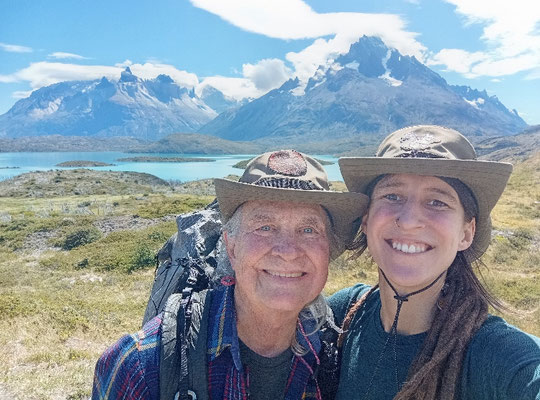

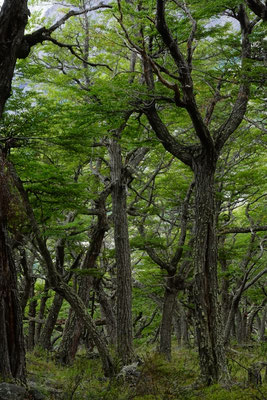

Crashing and burning on the W Trek ...

The next day is no less eventful. Just as the trail finally levels off for a moment, my husband trips over the only small, triangular rock and goes flying flat on his face. With his heavy backpack.
“Oh my God, did you fall on your face?” I shout in panic.
“No,” he replies.
Relief.
“But on my elbow.”
Panic. He’d broken his elbow just a few months ago in a very similar situation while backpacking on Wyoming.
Since there’s no good alternative to hiking on, we hike the remaining miles to today's camp.
Turquoise glacial lakes, alpine flowers, a little bit of fresh snow like powdered sugar on the sharp mountain peaks. Gosh, it is abnormally beautiful out here!

We’re feeling anxious at camp. My husband’s elbow is hurting. We decide to go to the ranger station. Unfortunately, the ranger we meet there only speaks Spanish. Using gestures and Google Translate on her phone (why does she have cell service and we don’t?), we decide to wait for her colleague, who’s trained in first aid.
When he arrives, he performs a few tests on the elbow. Possibly partly fractured, but likely not completely broken. The nearest clinic is four hours away by
catamaran and bus, in a small village. Since it was already clear during the fracture last summer that surgery wasn’t an option for various reasons, we agree that a splint will
have to suffice this time as well. Unfortunately, the first-aid kit on site only has splints for forearms and upper arms, but not for elbows. “I worked in Santiago for a few years,” explains the
ranger, as he unbureaucratically brings out a sturdy cardboard box, a carpet knife, and tape. “I know Street First Aid.” Shortly afterward, my husband has a
surprisingly solid cardboard splint on his arm.
“What are you doing tomorrow?” asks the ranger.
“We keep going,” says my husband. All right.

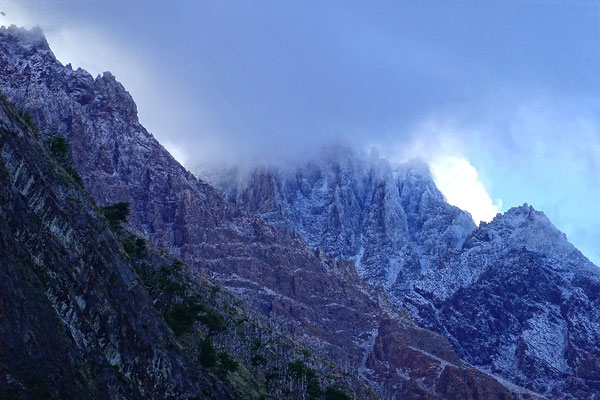

W Trek Patagonia: Storm and black Eyes

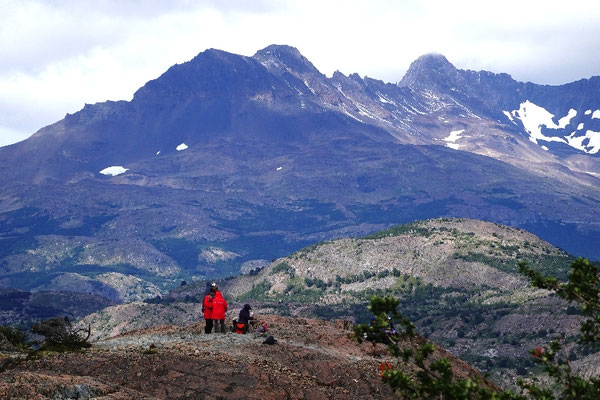
We’ll find out just how far you can go with an arm like that the next day. But first, a big storm lashes down on us during the night. Strong winds are a constant problem during Patagonia’s summer months—due to the westerly wind belt between a latitude of 40° and 50° (also known as the “Roaring 40s” and “Furious 50s”). But that night, the strong winds turn into howling gale-force gusts. As I lie awake in the tent, I first hear a whooshing sound, then a hissing like wet tires on asphalt. Then a gust of wind slams into our tent so hard that for a moment I see us flying, shredded tent and all, into the nearby glacial lake. Then silence. Then the next gust rolls in. The whole thing is just as loud as if a motorcycle engine were starting right next to my ear every few minutes. The next morning, we’ve slept for barely two hours. But the sunrise behind the purple storm clouds and the two-toned granite massif of Los Cuerrnos (“The Horns”) is absolutely amazing, and the tent is still standing.
That day, we first hike up and down the French Valley and then on to Camp Frances. Unfortunately, there’s no Camembert involved in this very French affair. But a black eye. When the path uphill into the French Valley becomes too rocky and rough for a potentially fractured elbow with a cardboard splint, we decide that my husband waits in the valley while I hike alone to one of the lower lookout points and then meet him back down later. On the way, I hear a deep rumbling. A thunderstorm? But the weather doesn't look like it. Strange.
As I make my way to the viewpoint, I see with my own eyes, right in front of me, where the noise is coming from. A huge chunk of glacier breaks away from the top of the mountain and thunders down into the valley amid clouds of ice, snow, and rock dust. Unbelievable! I’ve never seen anything like this in person before! In awe, I stare at the spot from which dust continues to rise for minutes on end.

As I hike back down into the valley after a while, I run into two people we met yesterday.
“Your partner is down there alone. He’s hurt,” they explain in broken English. They’ve probably seen the cardboard splint on my husband’s arm.
“Yes, I know,” I reassure them. “It happened yesterday.”
“Today!” they say.
“No, yesterday!” I assure them. “It's his elbow.”
“No, his hand!” they insist. “There was a lot of blood.”
Wait a minute? Blood? There hadn’t been any blood yesterday. I have a bad feeling about this…
After a frantic run back down to the valley, I find my husband sitting miserably on a rock, pressing a handkerchief against his knuckles, a gash on his cheek, and looking a bit dazed.
He actually tried to hike after me after all and slipped sideways off a rock in the process! I’m flabbergasted, a little mad, but above all relieved that nothing worse happened. The next morning, his right eye is swollen, red, blue, and purple.


Kidney Stones - 7 Miles with raging pain

The next day, my husband presses on, cardboard splint, black eye and all. Today the penultimate stretch—the longest and most grueling one—lies ahead of us. 10 Miles to the Chileno mountain camp under a blazing sun, with a steep climb over the last 2.5 miles. I’m impressed by how he’s pushing through. Hopefully he won’t get into any more trouble…
But today it’s my turn. Since I was diagnosed with the chronic inflammatory bowel disease Ulcerative Colitis in 2019, my medication plan has been so well adjusted that I can tackle hikes like the W Trek without hesitation. Well, almost without hesitation, because this medication has a rare side effect of causing kidney stones. I’ve already had nearly thirty of them over the past few years. In terms of pain, kidney stones are probably comparable to labor pains, and I seem to get them most often on strenuous hikes, where you're usually mildly dehydrated and stones get dislodged by the body’s extreme exertion. And today is one of those days. Of all days, today. On the longest and most strenuous stretch. Fail.

I push through the pain for seven miles. My hand clenched against my hip to fight it off. With stabs of pain like a knife that come and go like waves. With tears in my eyes and mantras in my head. No painkiller works. At least I’m not nauseous and dizzy, as I sometimes am. To the right, red mountains with green meadows and a glacial lake; to the left, spectacular granite massifs with ice fields and waterfalls. Then I can’t go on anymore. I throw my backpack and myself to the ground and briefly consider giving up just before the final climb. Then we eat crackers and cheese and rest for half an hour. My husband’s now purple-yellow eye looks just like how I feel. When I get back up, the pain is suddenly significantly less. Sometimes that happens when the stone moves. I walk in a circle. You’ve got to be kidding me? I almost want to jump and cheer. We pack up and start the climb. Then, in the distance, in the incredibly beautiful, golden prairie, we see a large animal. I pull out the binoculars. It’s a guanaco, a wild llama! I’m freaking out—how amazing is that? After eleven hours, we arrive at our last camp. The last camp before the grand finale the next morning.


Torres del Paine - Towers of the blue Heavens
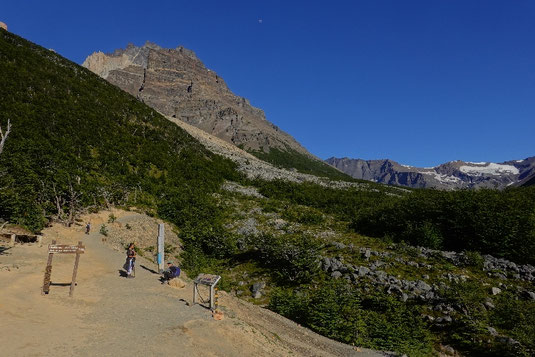
At the end of the W Trek—since we hiked from west to east—lies the absolute highlight of the trail. Though that’s absurd, because truly every bit of the landscape along this trail is more than gobsmacktically spectacular. Yet the Torres del Paine, three massive granite spires rising some 6500 feet behind a turquoise glacial lake, are the landmark of Chilean Patagonia. The price: a climb up the glacier’s nearly vertical, rocky terminal moraine, which packs a whooping 1000 feet of elevation gain into just one mile. Even though we’ve pushed through so much together over the past few days, one thing becomes clear quickly: climbing up here with a splinted arm would be life-threatening, because you need both feet and hands for the final stretch. My husband decides to stay at camp—this time for real!—while I tackle the final and greatest challenge of the trek alone. If one of us can’t go on, the other carries on for both of us, we’ve always said.
First, I walk through a wooded area, climb a dusty trail, and after about 1.5 miles reach a small plateau. From there, I look up at the almost vertical wall leading to the Torres del Paine, which you can’t even see from here. “Let’s go!” I say aloud to myself. There’s a fire inside me that has only grown stronger despite—or perhaps because of—all the accidents, storms, and pain of the past few days.

I start climbing. It’s hot, and I’m making slow progress. But no one is rushing up here anymore, everyone is breathing heavily. The path leads higher and higher, beyond the tree line. One step after another. Carefully. Don’t fall, don’t overexert yourself. When I can finally see the peaks of the granite towers, my skin is burning, but my legs are still strong. It’s amazing what just a few days out here under these conditions can do for the body and mind. Strength. Muscles. Optimism. Self-confidence.
And then I climb the last ledge, the last ridge on the way to the destination. A valley opens up before me, in which a blue-green lake lies like a silk scarf. Nearly thirty waterfalls cascade down the stony basin from a glacier field that lies directly below the huge, majestic, and now so incredibly close granite towers of Torres del Paine. I want to cry and laugh and throw everything away and dance! I take photos for my husband and for the hard drive. But the real images are etched into my mind and heart in this moment.
The W Trek. A journey through endless beuty, mountains and valleys, finding and going beyond our limits a hundred times and becoming people we weren’t when we set out five days ago, but who we will now be forever.
If you like, you can follow my stories and outdoor adventures daily on Instagram: @squirrel.sarah.
Find more hiking adventures here:
- Hiking in Patagonia: Laguna de Los Tres – foolish and unforgettable
- Long-distance Hike on the Laugavegur - with a tent and backpack in Iceland's Backcountry
- Hiking in Wales: Worm’s Head – Race against the Tides to the Island in the Sea
- Hiking in Luxembourg: Our short Long-Distance Walk on the Lee Trail
- Flower Carpets and Snow Balls in the Rocky Mountains – Three days in Paradise with a Tent