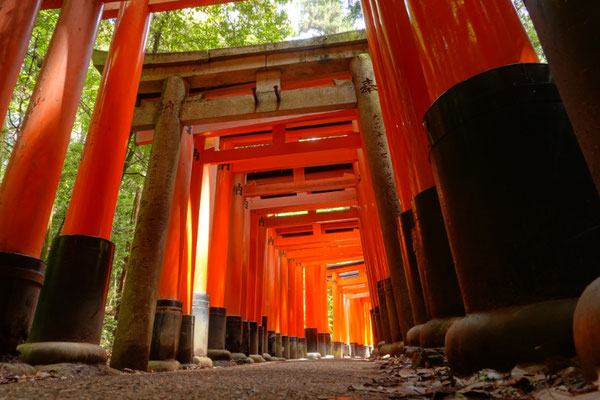
Kyoto: Spirit Animals, Moss Temples, and 10.000 Torii.

June 13, 2026
It’s warm and sunny as I turn onto a small side street on the wooded slopes of Kyoto. It instantly becomes quieter. There’s no official sign pointing to what I’m looking for, but
I know it’s there because I was here once before, nine years ago: a moss temple. And when I say “moss temple,” I don’t just mean a small tuft on the ground or a bit of green
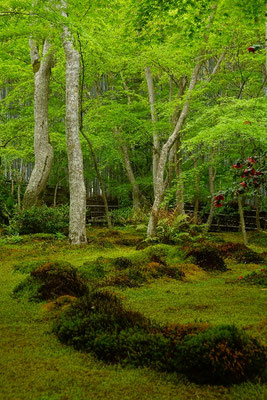
roofing. I mean MOSS. Everywhere. The entire temple grounds, surrounded by trees and tall bamboo, are covered in thick, lush carpets of moss in every shade from turquoise to
ochre green. Over thirty species of moss grow here in an atmosphere that feels as if you’ve stepped into a snow globe where eternal spring reigns. A spring of calm.
I’m spending a month in Japan. First, I’ll be traveling solo for a week and a half, then my husband will join me from the U.S. After visiting immersive museums and flower festivals in Tokyo, I took the Shinkansen bullet train to Kyoto. Here, time moves more slowly; here, the spirit of ancient Japan wafts through wind chimes, winding temple complexes, and the canopies of subtropical deciduous trees. Not in the modern city center, which is as gray and indistinguishable as any major city, but in the outskirts bordering the lush nature that surrounds the metropolis in the valley like a wall. I set out in search of moss gardens and a sea of stones, of spirit animals and ten thousand red gates. Time to let time be time and find a moment of tranquility in a city where Zen is not a trend, but a way of life.
The moss temple - a place of peace and calm
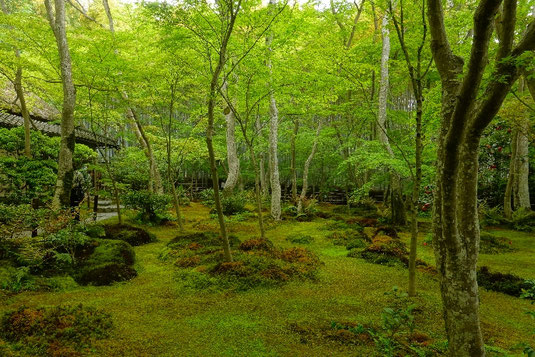
I’ll admit it, I’m a total moss nerd. Whenever I happen to spot broom forkmoss or thuidium tamariscinum on our hikes in Germany, I have to stop right there, pull out my magnifying glass, and go a little crazy. That’s why this little moss temple in Kyoto is paradise for me. I slowly stroll up the path to the temple as everything grows greener and the earthy scent of perpetually damp wood intensifies. There is moss growing even on the entrance booth. Then an area opens up that looks as if someone has scattered fluffy green beanbags across the ground. The entire ground—with the exception of the walking paths—is covered with thick carpets of moss. Now, in spring, the colors are quite different from nine years ago, when I was here in October. The green is fresher and at the same time brighter. Seed capsules are sprouting and dotting the fluff with orange specks. A small lizard scurries away on the path in front of me. Apart from it, nothing is in a hurry here. A temple employee is sweeping the ground with an old rake. Slowly and deliberately. I hear a warbling white-eye. Then a sign invites me to take off my shoes and sit down in the low temple building. On the floor, tatami mats made of pressed rice and rush straw; on a shelf against the wall, Buddha statues; outside, water splashes from a bamboo pipe into a metal barrel, producing a soothing, hollow, and warm sound. A place to stay.



Adashino Nenbutsu-ji: 8000 gravestones – will we be forgotten?
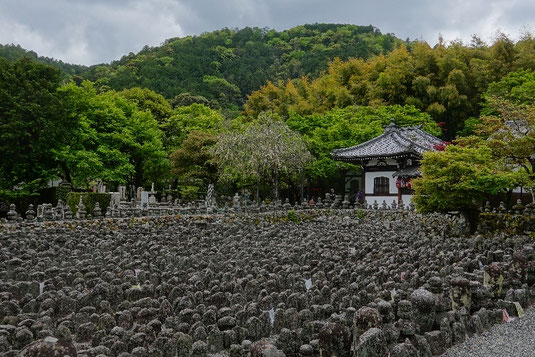
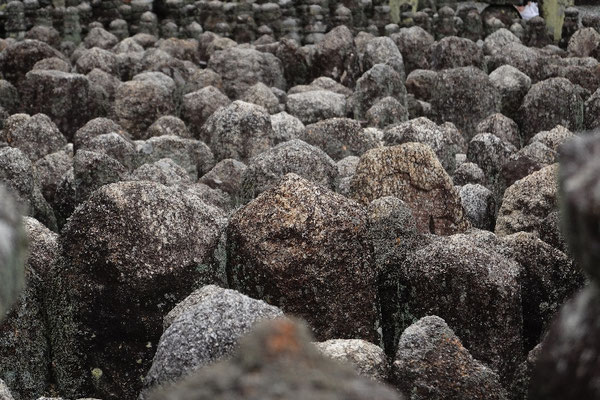
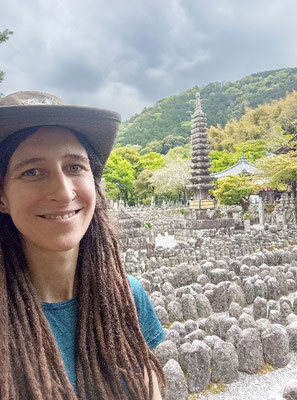
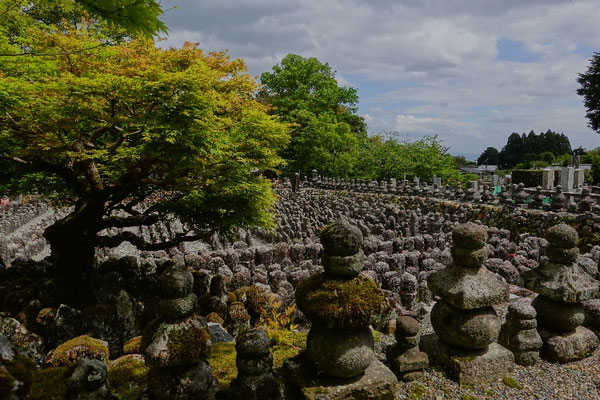
Talking about "staying". More than 8,000 gravestones have survived several centuries and are now standing arranged in a small rectangle within the grounds of the Adashino Nenbutsu-ji temple. They lie before me, gray and jumbled, like a rough sea. No one knows exactly who was buried here over time. The remains of people who had no relatives or were poor were left here to the elements between the years 800 and 1200 of the Common Era. Sun and wind decomposed the bodies. In the 19th century, hundreds of weathered gravestones were gathered from the surrounding hills and, in some cases, even dug up because time had swallowed them so deeply. To finally give the deceased a dignified place, they were arranged within a sacred rectangle, surrounded by a low stone wall. A place one might think is eerie—but it isn’t. The nameless stones stand peacefully close together, as if offering each other comfort, with a tall, slender stone pagoda in the center. Every August, the Sento Kuyo ceremony takes place here, during which hundreds of candles are lit in remembrance at night within the rectangle. Something I would very much like to experience. Something Japan does well: showing respect and dignity.
What is it like to imagine that one day no one will know who we are anymore? That our gravestones will crumble and our names will fade? Did you ever get to know your grandparents
and great-grandparents? What do you really know about them? What will our grandchildren know about them? How important is it that we are remembered, or does only what we are and
do in this very moment really matter in the end?

Omikuji animals in Kyoto – good fortune to go

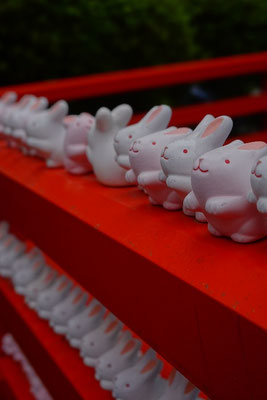
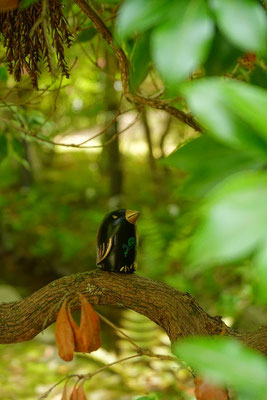
SQUIRRELS! No, I didn’t just say that to lighten the mood—there really is a squirrel shrine in Kyoto! And that’s not all: the city is home to countless temples and shrines dedicated to various “messenger animals” that act as intermediaries between humans and the gods. The coolest part: You can find these little animals as omikuji figurines made of ceramic or wood to take home at many sacred sites. By the time my husband joined me halfway through my stay in Kyoto (he’d had surgery on his broken leg back in the U.S., but didn’t think that was getting in the way of flying 6,000 miles to Japan), I’d already started a little collection of figurines.
Omikuji are traditional Japanese fortune slips that can be found in boxes, drawers, or inside small, hollow animal figurines. They predict the future in various areas of life and aren’t always good. If you accidentally draw a bad fortune, you can tie the slip to a string right on the temple grounds and leave it behind. Luckily, the translations of the fortune slips with Google Lens are so cryptic that I don’t even have a clue whether I’ve drawn good or bad luck. The main thing is that I’ve got the figurine!
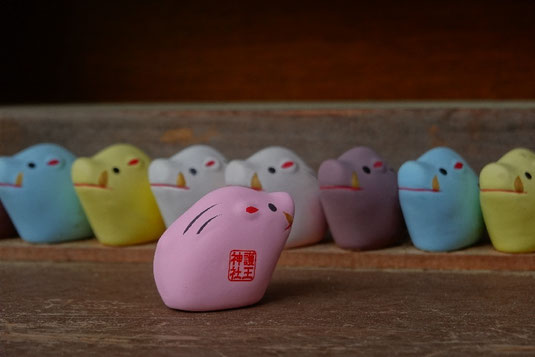
My husband and I both believe in spirit animals—animal guardian angels that appear during difficult times in your life to offer inspiration or guidance. For me, it’s the squirrel, and for him, the raven. Surprisingly, there are actually two shrines in Kyoto dedicated to each of them. Of course, we have to go!
A few days later, I find another place of worship dedicated to the wild boar, which, according to legend, takes special care of people with foot, leg, and back problems. Since I tore the ligaments in my foot just a week after my husband broke his leg (guys, we weren’t even hiking—we both just fell down our stairs at home, no kidding!), it seems only logical that we seek out the magical wild boar. The ceramic figurine is also pretty darn cute, so we toss a coin into the offering box and make a prayer. Can’t hurt to try. Unfortunately, the omikuji in my figurine says that physical ailments currently take a long time to heal. Should I leave the slip at the shrine or not?

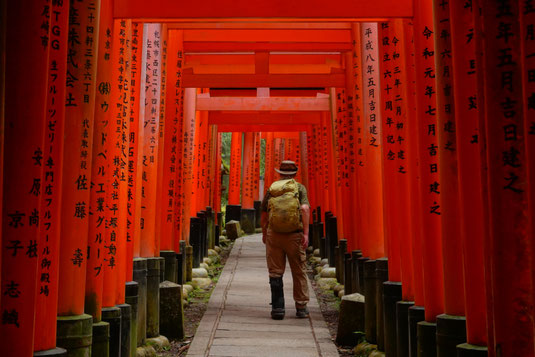
Fushimi Inari in Kyoto: 10.000 red torii, 12.000 stairs
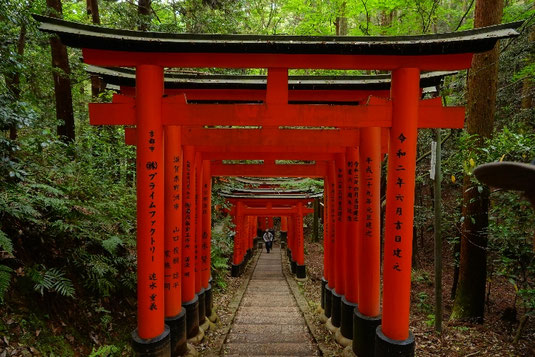
Whether the wild boar helped or not—nothing can stop my husband from going all out at Fushimi Inari. Fushimi Inari is a sprawling shrine complex in Kyoto known
for its absolutely insane number of 10,000 red torii gates, which line a circular hiking trail up a mountain—Mount Inari. A total of 12,000 stone steps lead up
and down. By the time we’ve covered about a third of them (the doctor has allowed my husband to put weight on his leg “up to his pain tolerance,” but the word “pain tolerance” always has a
somewhat crazy definition for my husband), I’m pretty wiped out. We’re standing at an overlook with a sweeping view of modern, not-so-beautiful Kyoto. As far as
I’m concerned, we could just sit here for a while and then head back down. “Do you still want to go up the mountain?” I ask, rather sheepishly.
“Sure!” says my husband enthusiastically.
So we head up this mountain. The trail is 2.5 miles long in total and lined almost continuously with red torii gates. Normally, it takes about two hours to
complete the hike. But we’re on the trail for nearly five. Hobbling. But with the absolute determination to hike up this mountain now. Along the way, we see small shrines and
prayer places over and over again. There are said to be over 10,000 of them along the route. Is there anything here that comes in under 10,000?
By the end, we’re both pretty exhausted, but it was also absolutely wonderful. By the way, the first 200 yards on the trail are total tourist hell, with at least 10,000 selfie sticks—but here, too, as is so often the case, are those, who take one more step, rewarded with peace and quiet. Or 12,000.
If you like, you can follow my stories and travel adventures daily on Instagram: @squirrel.sarah.
Find more stories from Japan and Asia here: