
Hiking in Japan: Wild Hokkaido - Snow Walls, Vulcanoes and Phlox-Magic.

June 27, 2026

Sweaty and with snow caked ankles, I set foot on the crater rim and am nearly blown over. Gusts of wind shoot sideways; before me lies a black-and-colorful desert of lava, and
just a few yards away, steam rises from a fissure. “Wooaaaah!” I shout into the howling wind, laughing, waving my arms about, absolutely thrilled and mildly concerned. I’m hiking in
Japan—on Mount Tarumae in Hokkaido, which is an active volcano. I hadn’t really given it much thought. Sure, it could erupt at some point, but I’d probably just see a
few old dormant boulders lying around. But this thing is steaming—and not just a little! In front of me is the newly forming lava dome in the middle of the old
crater, which was created by two Plinian eruptions in 1667 and 1739. “Plinian” means “similar to the eruption of Vesuvius that led to the destruction of Pompeii.” Like I said, I’m mildly concerned. Besides, I’m completely alone here; it’s April and still pretty
snowy in Hokkaido. I only encounter two other hikers along the way, and they’re already heading back down. “Volcaaanooo!” I shout loudly and sillily. Now that I’m already up here, I
might as well walk all the way around the crater. 3 miles. The wind is still howling, and the cone is steaming like a sleeping dragon, slowly breathing in and out. I text my husband, who’s
waiting at the foot of the mountain—he broke his leg recently and isn’t quite ready for crater-caramba yet—and set off trudging.
We’re traveling Japan for a month—Tokyo and Kyoto are already behind us, and now it’s on to the wild north: Hokkaido. Where walls of snow tower, the ground bubbles, and moss phlox covers the slopes with a
fluffy pink blanket. A place of extremes, caught between fire and frost. Let’s go!
Hiking in Hokkaido: Crept out on Mount Tarumae

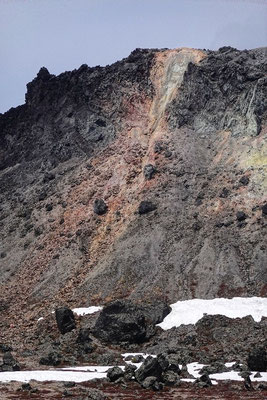
Full of energy, I start hiking. Wow, this is crazy—sulfur steam is billowing out of all kinds of crevices. It smells wonderfully like Yellowstone—like rotten eggs. The lava rock is black, brown, yellow, red… on one side of the lava dome, it almost looks like a petrified slide made of fire. It’s kind of fantastic, but also a little creepy. I pick up the pace a bit.
Down in the valley, there had been a sign warning about bears. Wild bears in Japan are definitely a problem. During the 2025–2026 season, there was a record number of attacks on humans, with 283 people injured and 13 fatalities.
I will mention this again and again: Wild bears aren’t the plush teddy bear with button eyes on your couch. One of the best ways to avoid them is to hike in groups. Well, but here I am, all alone.

The views from the rim of Mount Tarumae’s crater are breathtaking. The blue Shikotsu Crater Lake within sight, an endless brown plain at my feet, snow-capped mountain ranges on one side, and the sea on the other. Epic. When I reach the back side of the lava dome, I lose my cell phone signal. I check my satellite phone. Just in case. But in what case? I look at the steaming vents, then think about the bears again, then notice that the sky is clouding over and that there really isn’t a single other person with me on this crater rim. I feel a brief pang of unease. My mind is playing tricks on me. I sing “Das Wandern ist des Müllers Lust”, an old German folk song, at the top of my lungs. Then I slowly calm down.
On the way back, several deep snowfields still await me. When I finally arrive back at my husband’s in the valley after three hours—with wet feet (I was only wearing low-cut trail running shoes) and looking a bit disheveled—and he asks if I’d had an adventure, I have to laugh. Well, you bet I did.


Noboribetsu Hell Valley: Hokkaido's Purgatory
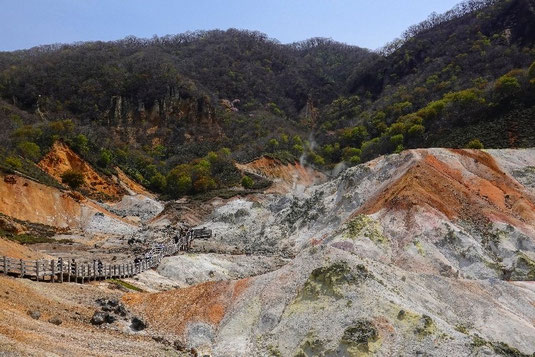
Mount Tarumae is just one of 31 active volcanoes in Hokkaido. Hmm… where there’s volcanic activity, there are often colorful hot springs and geysers, too…? I’m thinking of Iceland, Yellowstone, and New Zealand. A quick search is done—and sure enough, Hokkaido is home to Noboribetsu Hell Valley.
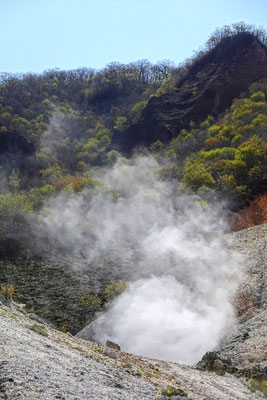
A valley full of orange-and-white, jagged, steaming rocks lies before us. It looks as if someone had blown something up here. And that’s actually true. Except it was the Earth. Noboribetsu Hell Valley is a caldera (a huge crater) that was formed 20,000 years ago during the eruption of Mount Hiyori. What we perceive as spectacular bubbling and steaming are merely the smoldering remnants of what once erupted here millennia ago. We walk into the valley on wooden planks, because anyone who strays from the paths runs the risk of falling into boiling water. Not exactly my favorite.

A bit of a letdown are the Niagara Falls vibes, because the area is surrounded by ugly concrete hotels. Even in the valley itself, construction machinery stands right next to beautiful steam vents in some places. Maybe the volcano could just erupt again and make this human "architecture" disappear… ahem.
We make our way up through a partly bare forest with crisp, dry leaves to the Oyunuma Hot Spring. In Hokkaido, spring is still in its early stages in May. The lake has a milky-blue color with some black patches and an area of almost garish turquoise.
If this is Hell Valley, the devil has a soft spot for bold, abstract art. A few feet further on, I spot a sign that says “Foot Bath.” Excited, we hike over—and sure enough, by a small stream there’s a wooden walkway where you can officially dip your feet in pleasantly lukewarm thermal water. A dream!



Snow Walls and snow volcanoes at Daisetsuzan Nationalpark

From fire to ice—our trip to Daisetsuzan National Park a few days later turns out to be a bit of a fail. While the cherry trees are in bloom down in the valley, along the road leading uphill to the visitor center we first see small patches of snow, then a solid blanket of snow, and finally walls of snow so high that we can’t see over them. WTF! It’s almost mid-May and the entire park is covered in snow.
“Is there any hiking trail without snow?” we ask at the center, feeling slightly desperate.
The ranger smiles. “No, not a single one.”
Hokkaido lies in the path of freezing Siberian winds from Russia. Due to the “lake effect,” the air blows over the relatively warm Sea of Japan, absorbs massive amounts of moisture, and then dumps it on Hokkaido’s mountainous coast in the form of several feet of snow.
Especially here in the subpolar Daisetsuzan National Park, winter temperatures often hover around minus 5°F. Fun fact: We find out that “Daisetsuzan” means “Great Snow Mountains” in English. Ha ha. When can you hike here? From mid-July to mid-August. For one month. Then the snow returns.
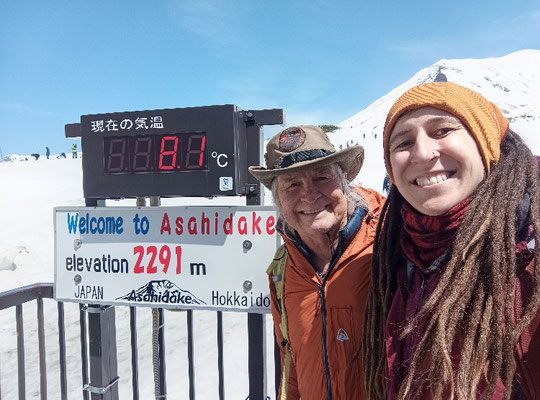
Before we head back home without doing anything here (snowshoes or skis aren’t an option because my husband is still wearing a splint on his leg), we discover that a cable car goes up to the summit of Mount Ashaidake. So let’s do that!
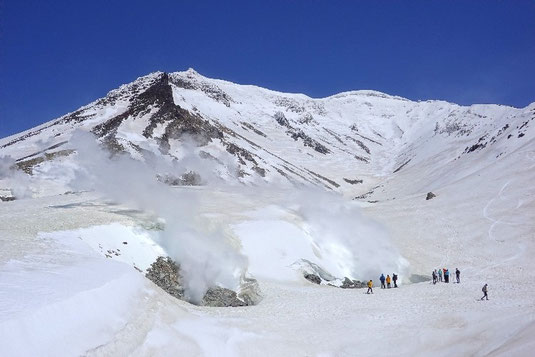
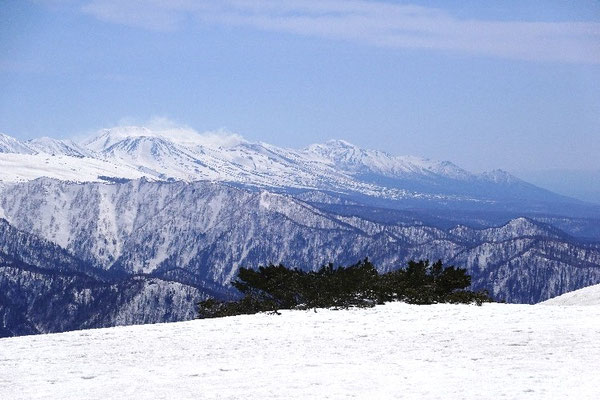
There’s still almost ten feet of snow at the top, and I make my way a bit cross-country toward the crater. Yes, Mount Ashaidake is also a volcano. And it’s steaming here, too.
Fumaroles are rising from the snow—crazy! I’ve always wanted to see something like that. Now I am here. Everything happens for a reason, after all.


The Moss phlox magic of Hokkaido
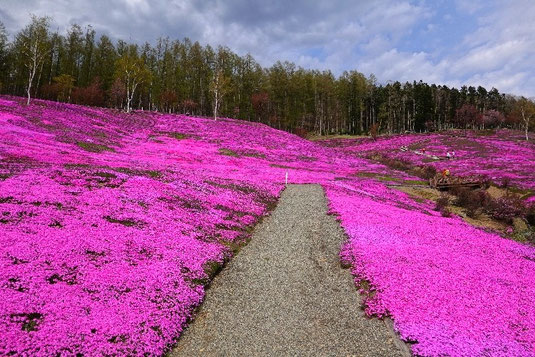
Japan knows how to celebrate flower festivals big time—I already noticed that in Tokyo. Huh—but wasn’t there snow just a moment ago? Yes, Hokkaido’s topography is so diverse that it has everything from alpine tundra to a maritime coastal climate. Especially places that turn into pink carpets of flowers in May. Do any of you have a patch of moss phlox in your garden? Yes, that one—but now imagine it's spread out over 25 acres.
When we arrive at Takinoue Park, we can already see a bright pink expanse on a mountainside from a distance. That can’t be real, can it? Did someone paint that? When we get out of the car, we realize, of course: it’s all real. And it smells wonderful! Small walking paths, some with wooden bridges and stairs, wind through the grounds. In the background are mountains; above us, dramatic dark clouds and rays of sunlight that make the moss phlox look especially colorful and almost exaggeratedly vibrant. No flower is the same. Some have round petals, others more triangular ones. Some are almost red, others pink or white. It’s an endless row of magic and something that’s hard to fully grasp with the mind.

In 1954, there were rows of cherry trees here. Then a typhoon struck and wiped everything out. Three years later, park manager Heiji Kataoka brought a small orange crate filled with cushion phlox seedlings and planted them at the entrance to Takinoue Park. Over the following decades, the entire village worked together to care for the flowers—until they grew into the 25 acres we see today.
Every great achievement begins with something small. If you can’t believe in the small things and commit to them, then nothing great will ever come of it. And sometimes, to make that happen, we have to work together—not against each other. By the way, cushion phlox is called shibazakura in Japanese, which means “ground cherry blossom.” Isn’t that beautiful?
If you’d like, you can follow my stories, discoveries, and adventures daily on Instagram: @squirrel.sarah.
Find more stories from Japan and volcanic places here:
- Tokyo: From digital Art to Mount Fuji's Flower Fields
- Kyoto: Spirit Animals, Moss Temples, and 10.000 Torii
- A Troll Rock, Winter Camping and Whale Watching – Northern Iceland: Road Trip Iceland
- New Zealand North Island: Champagne Pools, Devil's Baths and volcanic Lakes
- Backcountry Camping Yellowstone: Shelf Clouds, Snow and the perfect Moment


