Penguins in Patagonia:
Where the Fluff lives.

April 10, 2026
We'll probably end up seeing just a few black-and-white spots way off in the distance, I think. Spotting wildlife is always a bit of a gamble. You can’t just open an app and have the animals magically appear. You have to search and wait and be patient and wait, and in the end, you might see nothing—or something absolutely wonderful.
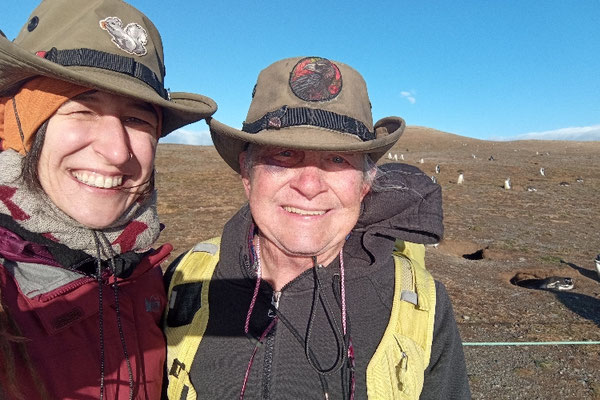
We’re looking for penguins on the Strait of Magellan in Patagonia, Chile. The ferry cuts through rough sea. I do get seasick sometimes. But never mind now. Penguins! These little creatures in tuxedos, waddling across grass, ice, and snow with arms outstretched, threatened by climate change and other human-caused hardships. I want to get to know and understand them better; not behind bars in a zoo, but out here.
My husband gazes calmly at the waves. I hope, feeling slightly queasy, that we’ll be there soon.
Then we dock. I look out over the shore of Magdalena Island, where large, round, smooth rocks lie in the surf. Wait, isn’t something moving over there? I slide right up close to the window, and my jaw nearly drops. There are penguins! Right there, just over on the beach. Exactly where we’re about to walk. Of course, in a designated area so as not to disturb the animals. “There!” I shout like a child, pointing through the boat’s window at the scene outside. My husband grins. He’s had to listen to me say three thousand times today just how much I’m looking forward to the PENGUINS (all caps). Now we’re here. With the Magellanic penguins in Patagonia—and about to take a little walk, guests in their world.
Loop Trail with strict Rules - Penguins on Magdalena Island
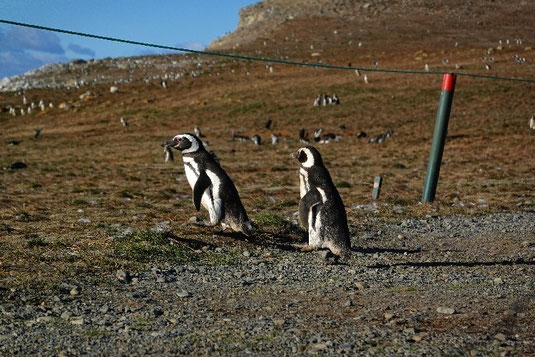
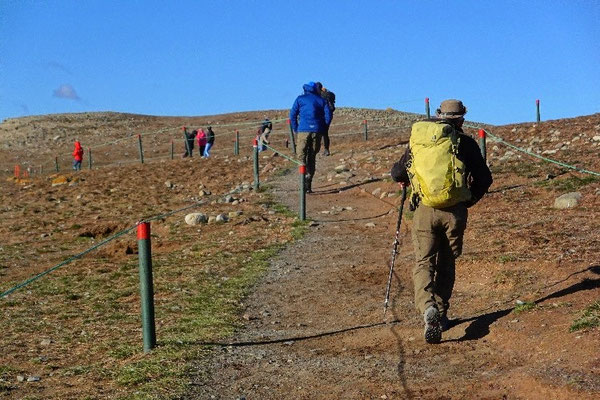
Before we set foot on Magdalena Island, we’re given a set of rules in all the standard tourist languages. The guides make sure we all understand that we must not touch the penguins, feed them, or come within seven feet of them; they always have the right of way when they cross our path; and we must not stray from the path marked by the ropes. Bringing food and drinks is generally prohibited. So is waving around selfie sticks. I think that’s great—and surprisingly, for once, no one acts like a total jerk during the next hour on the island. That’s cool for a change. I’d love to run off the boat and shout “PENGUINS!” Of course, I don’t. Just very quietly, in my head.
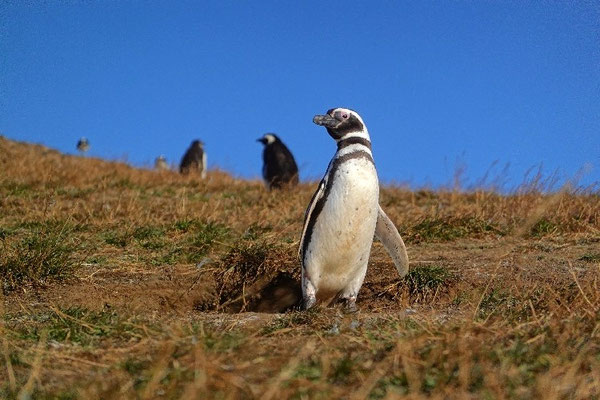
Then we’re off. A loop trail covers only a small part of the island; access to other areas is strictly prohibited. It soon becomes clear: the penguins know this. Every morning at 9 a.m. in the summer, a little nutshell of a boat comes across the Strait of Magellan, then big penguins in colorful outdoor gear with rectangular devices in their hands get out, walk in a circle inside the ropes, are smiling and pointing big time, and sail off again. Accordingly, they’re unimpressed by our presence. Some waddle leisurely across the barren grassland, arms outstretched, as if they were waiters. Others lie in front of their nesting burrows. Yes, that’s right—Magellanic penguins nest in the ground to protect their chicks from the sun and predators. Plus, they often stay together as a pair for many years.

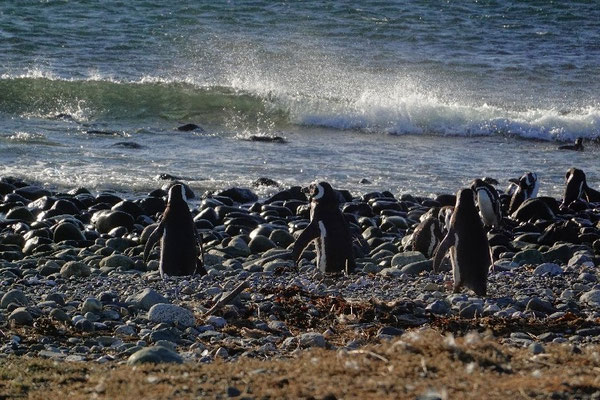


Penguins - free and respected on Magdalena Island

It’s an incredible feeling to have these little animals roaming freely all around you. They aren’t here for our entertainment; they haven’t been caged, trained, or rounded up to amuse people. They live here. At one of the southernmost points of Patagonia. I’d love to ask them what they think of us. If it’s okay that we’re here.
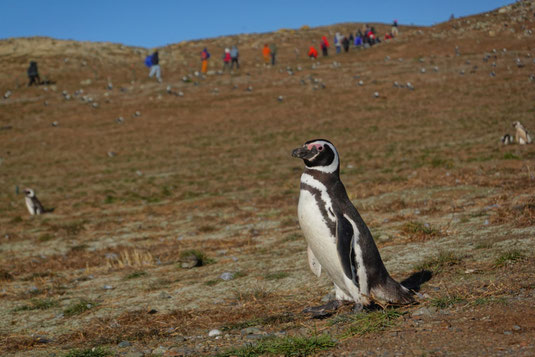
Three penguins come in a row over the hilltop, marching sternly and also a bit comically toward the human footpath and crossing it, while we stop at a respectful distance and marvel. Many rectangular boxes are held aloft. Some are taking photos, others are filming. People ranging from small children to elderly gentlemen are full of joy and excitement (I can especially confirm the latter—my husband is thrilled). What a beautiful moment of admiration and respect. The world could use more of this.
At the highest point of the island stands a small lighthouse. In addition to the penguins, there are also many seabirds about. There’s always something twittering, screeching, and fluttering here. But I have to admit that the PENGUINS steal the show a bit from all the other animals.
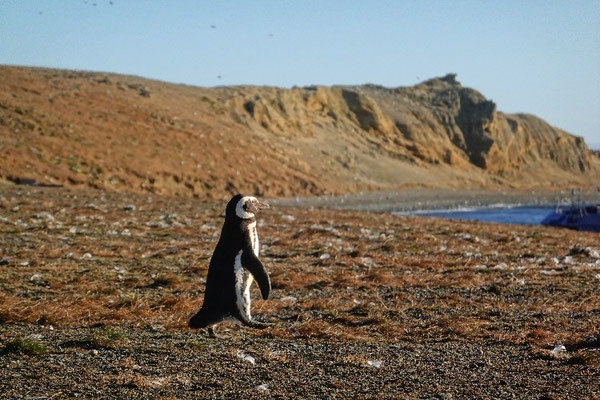

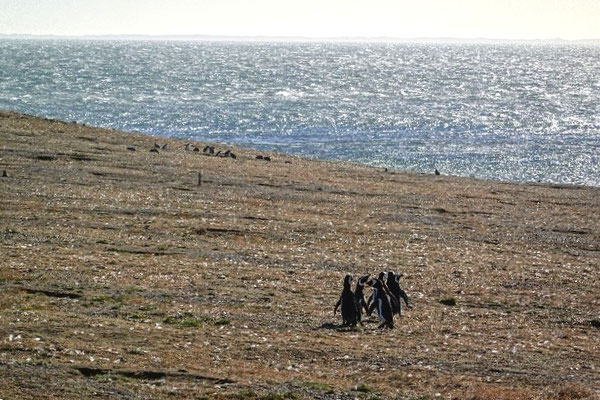
Magellan Penguins are endangered
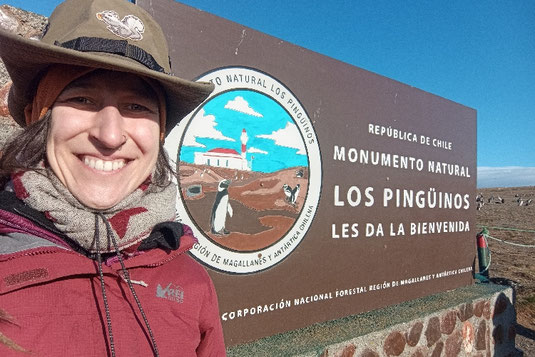
A fierce wind is blowing on Magdalena Island. Fierce winds are a hallmark of Patagonia’s summer months. If you’re not careful, everything gets blown away: your hat, your cell phone, your toupee. The penguins don’t mind. They like it rough, they can handle the cold, and they plunge into the waves. After all, they’re equipped with plenty of feathers and down. What is troubling the Magellanic penguins, however, is the measurably changing climate. Heat and droughts are drying out the island’s fragile soil and causing the penguins’ nesting burrows to collapse. Warmer seawater means fish no longer come—and penguins eat fish. In addition, many of the cargo ships passing through the Strait of Magellan carry oil. Even if there is no major accident, oil spills into the sea every day—mostly during transshipment. Oil destroys the insulating and water-repellent properties of penguin feathers, causing the animals to freeze to death and drown. To protect the Magellanic penguins, the Los Pinguinos Natural Monument was established as early as 1966, designating the area around Magdalena Island as a special nature reserve. Since then, a 20-mile-wide no-fishing zone has been established around the island, as overfishing by humans has been another threat to the penguins.


Very close, very intense
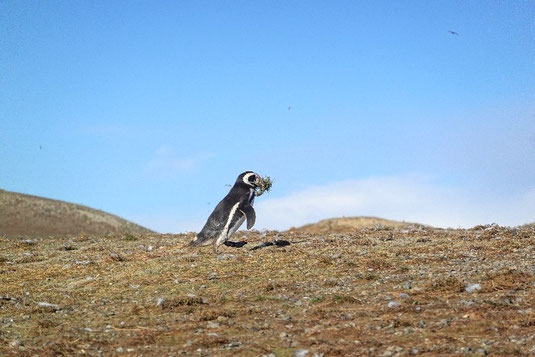
During my time on the island, I don’t speak much. I’m living in the moment. This might be the only time in my life I see penguins, and this is it. A few animals seem to be deliberately basking in the sun and enjoying it. Eyes closed, feathers fluffed up. I wonder what it would feel like to wear that thick layer of insulation and be immune to the biting wind that tugs at our colorful outdoor clothes?
The penguins are so close and relaxed that I just watch them for a while, silently. Their eyes, their beaks, their feet. Being close to a wild animal without being perceived as a threat—that’s always something very special. The time on the island feels like an entire morning. There’s nothing else to do but watch penguins. I’d love to have an hour like this every day of the year. Maybe we should all be more like this and let things be. Rejoice in what is (still) on Earth and protect it so that it will still be here after we’re gone. As I say goodbye, I wave to the penguins and whisper, “Thank you.”
If you’d like, you can follow our stories and outdoor adventures daily on Instagram: @squirrel.sarah.
Find more moving wildlife encounters here:
- In Search of Puffins—Roadtrip Norway Lofoten Islands
- More than giant Tortoises - A thought-provoking Trip to the Galapagos Islands
- 5 Days in the Amazon Rainforest: Adventures in a fragile World
- Wow, Etosha! Grinning Giraffes and intimidating Elephants in Namibia
- Bear Encounter in Canada: The Moment that was too close
- Chitwan National Park Nepal: In a Tree House at Night with Rhino