5 Natural Wonders of Andalusia: Hanging Trails, tall Cliffs and Europe's only Desert.

August 19, 2018 / Update: March 28, 2026

I’m standing on the outskirts of town and, at the same time, on the edge of a magnificent, rocky precipice. My best friend and I are on a three-week road trip through Andalusia, looking down from the city of Ronda into a 300-feet-deep abyss. It’s as if the white houses of Ronda are spraying out over the edge of the cliffs like sea foam. At the same time, the pale, warm evening light is settling over the landscape. Then the lights come on at the bridge Puente Nuevo, bathing the gorge between the two parts of the city in fiery orange.
From here, our excursions to a few true natural wonders of Andalusia begin. Because next to larger cities like Seville, Granada, and Málaga, there are also secluded beaches, jagged mountains with dizzying hiking trails on wooden planks, and rocky landscapes that rival some of the national parks of the USA. Come along to five beautiful natural spots in Andalusia. Hope you are unafraid of hights and up for an adventure?
1. Caminito del Rey

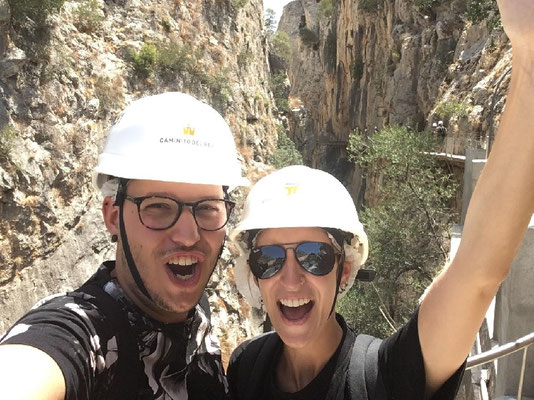
After parking our car with a bit of caution just inches from the edge of a cliff beside the road, we take one last look at our pre-booked admission tickets and set off. Off we go to the Caminito del Rey hiking trail. For a while, the path was considered one of the most dangerous hiking trails in the world because it was in such poor condition. It was even officially closed to the general public.
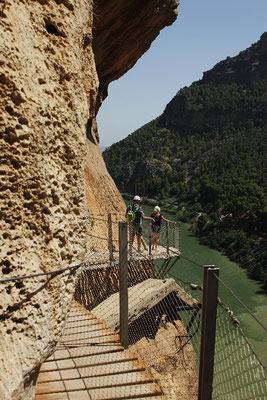
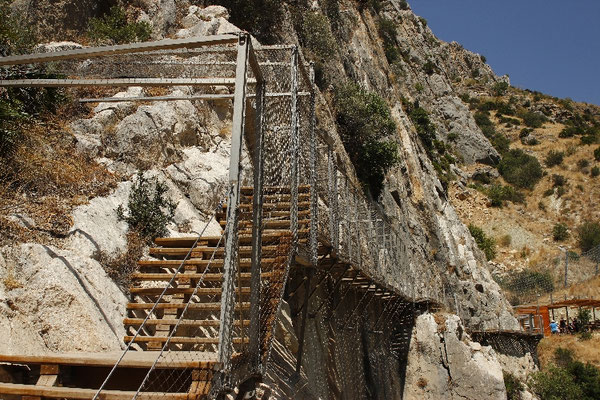
The trail was built between 1901 and 1905 and spanned the Gaitanes Gorge “to facilitate better communication between the communities on either side.” Sure, so in 1901 they just casually built a two-mile-long, completely insane hanging walkway along vertical rock faces "for better communication". Today we’d just use WhatsApp and ChatGPT for better communication. Okay, I seriously doubt that this kind of communication is actually better, but that’s a different topic.
Unfortunately, this Andalusian architectural and natural wonder fell into disrepair over time until it was unrecognizable. That didn’t stop quite a few people from climbing the Caminito del Rey anyway. Between 2000 and 2010 alone, quite a few people crashed and burned—ten of them died. In March 2015, the trail reopened to visitors after a complete restoration—and was, of course, promptly overrun. That’s why there’s a ticketing system that allows only about 15 to 20 people in every half hour.

On the one hand, this means you’ll be pretty much on your own on the trail, free to enjoy the thrilling natural scenery without any time pressure (there is no need to get off the trail after a certain time)—or to get a proper feeling of dizziness from looking down into the gorge. On the other hand, it also means that tickets are limited, so it’s best to book them online in advance. Depending on the season, they can be sold out up to three months in advance. They currently cost 10 euros for a self-guided tour and 18 euros with a hiking guide.
The Caminito del Rey is not a loop trail. So you’ll either have to walk the same route back or buy a bus ticket at the end to take a shuttle from the south
entrance back to the north entrance. The Caminito del Rey is no longer dangerous! Still, nerves do get a little frayed here and there when you look through the wooden planks into
the 300-feet-deep abyss, through which a turquoise river roars. The landscape is breathtakingly beautiful. As we walk along the trail, a strong wind whistles, which makes the
scorching 100°F temperatures in August a bit more bearable. However, the gusts also set the trail’s highlight—the free swinging bridge over the gorge—in motion. On this day, it’s
swinging particularly freely... my best friend is afraid of heights and is not amused. But he made it and was glad he did the trail.
You receive helmets from the operators of the Caminito del Rey at the entrance. They are mandatory and a safety measure for insurance purposes. The hiking trail itself is about
two miles long. The walk from the parking lot to the trail’s north entrance is about one mile (partly through a tunnel), and the path from the end of the trail to the south
entrance is another 1.6 miles. The entire hike takes about four hours at a leisurely pace with plenty of stops to take in the amazing views and lots of photos. There is no
technical climbing involved, and my best friend managed the trail despite his fear of heights and would do it again.

2. Torcal de Antequera

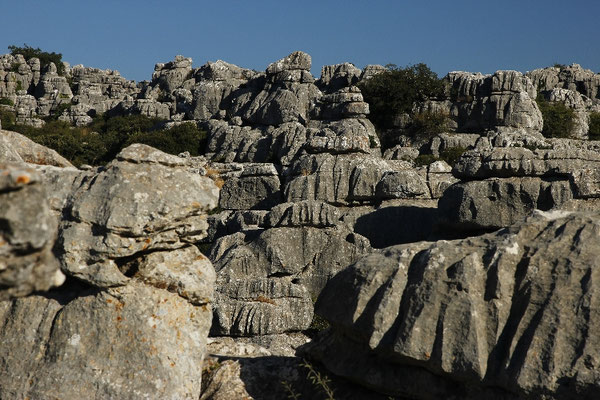
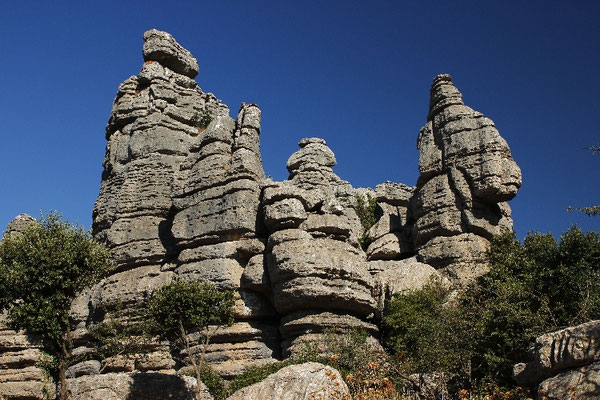
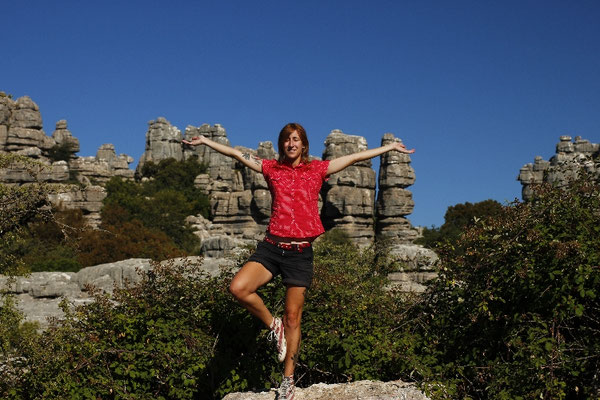
“This is almost like Bryce Canyon in the U.S.—only in gray!” I exclaim, completely blown away. The jagged rocks of the Torcal de Antequera tower up against the blue sky like enchanted statues. What’s going on with nature in Andalusia? Which little elf built this crazy stone city? Wow!
From among all possible paths we choose the medium-length trail and hike for two hours over rough stones, dust, and branches. Ever-changing magical rock formations rise up like cathedrals to the left and right, while an eagle circles silently above us. Suddenly, there’s a snorting sound. We stop.
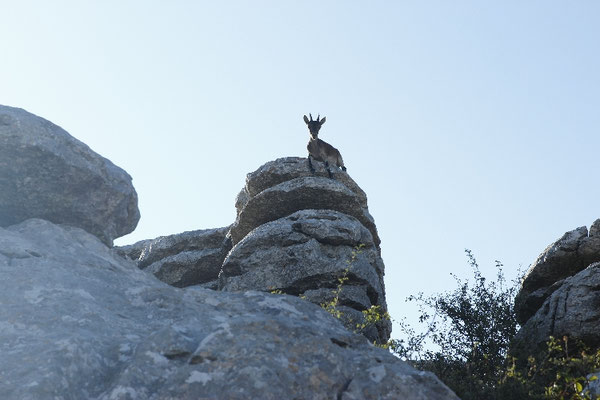
Diagonally across from us, a goat walks across the deep crevices as if strolling down a promenade—easy peasy. Definitely ten times more elegant than us... Especially when I slide my butt across a stone slab because I don’t dare jump down. In general, though, the Torcal de Antequera is easily accessible without hiking gear or experience. It’s still quiet and even cool in the middle of summer around 9 a.m. Plus, the morning light is fantastic!

There’s also a shorter hiking trail for families with children and a longer trail, though it’s not a loop. You can park for free at the visitor center and—important for old souls like me—even drop off postcards.
It’s hard to imagine, though, that millions of years ago there used to be an ocean right here—right in the area that's now the Andalusian mountains. The sea formed layers and layers of limestone from rock deposits. When Europe and Africa finally collided, the landscape folded and bent into this unique shape. Today the area lies between 3,600 and 4,500 feet above sea level. If you have binoculars with you, you can spot not only goats but also reptiles and an incredible number of birds. We spend an entire morning marveling at the rock formations that look as if they’ve been stacked up, realizing once again that no amount of architecture and design, no matter how impressive, can rival the beauty of nature. Admission to the Torcal de Antequera is free.
3. Sierra Nevada

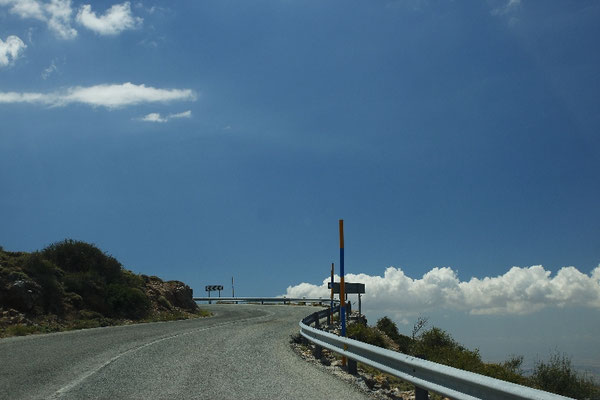
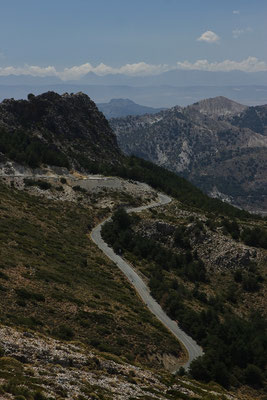
The road winds its way down into the valley like a tangled shoelace. The large, green lake at the bottom is now just a tiny speck glimmering in the landscape. We’ve driven up to about 6,500 feet elevation, coming from Granada north into the Sierra Nevada an the El Dornajo visitor center. It’s a quick trip, taking only about 30 minutes.
Our rental car roars in second gear as we huff and puff our way up the steep mountain roads. Behind the dark fir trees, a view emerges that I would gladly throw myself off a cliff for—if that weren’t counterproductive.
We stop countless times in the small pull-offs along the roadside and then drive on to the Mirador Monte ahi de Cara. This is the moment when I’d love to pack up the breathtaking landscape into little bags and save it for later or take it home in a box.

Unfortunately, we don’t see any snow at this altitude in mid-August, but it’s a pleasant 70°F, and there are lush forests, barren steppes, and white cotton-like clouds all around us. The Sierra Nevada is largely a pure nature reserve and has very few roads. At certain points, you can only keep going on foot, which we unfortunately cannot attempt because we want to continue on to the Tabernas Desert the same day—a trip that can easily be done in a day without rushing. But our little road trip is definitely enough to get a great glimpse of the Sierra Nevada. You can also visit the wonderful white villages like Bubión or Trevélez in the southern part of the region. However, there is no road leading to these villages from the northern Sierra Nevada near El Dornajo. You’ll have to allow several hours to drive all the way around the mountains. Also keep in mind that the roads are winding and narrow, and you can frequently only drive 15 to 30 mph. It’s not dangerous, but five miles can feel like a looong drive here, so you shouldn’t pack too much into your daily schedule. By the way, in winter, the Sierra Nevada is a great ski resort. There is no general admission fee to the nature park.

4. Tabernas Desert
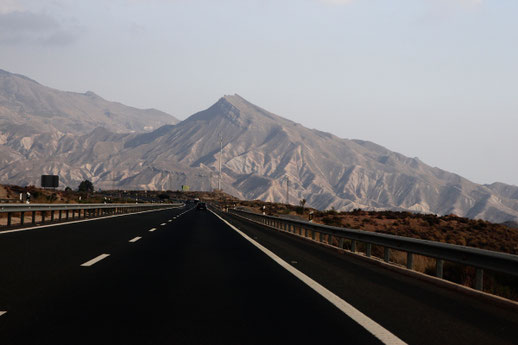
Europe’s only desert—wow! Europe’s driest place—even more wow! And then what happens? An apocalyptic thunderstorm with lots of rain comes down. Welcome to the Tabernas Desert!
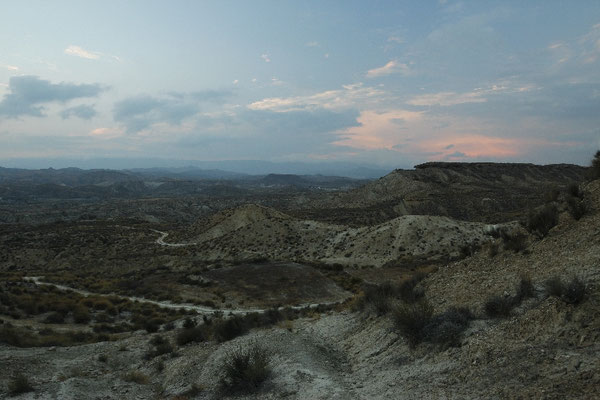
As we are finally able to slow down the windshield wipers, a landscape that would fit perfectly into the American West opens up before us. Memories of my four-month solo trip through the U.S. in 2017 are flooding back, as we zipp down what feels like a 50 percent incline toward the pastel-colored mountains with their undulating, wrinkled shapes.
During the day, temperatures in the Tabernas Desert can reach up to 120°F. Sizzling. There are about 3,000 hours of sunshine a year. Except for the three hours we happen to be passing through. Haha. Here, too, you can park conveniently at the visitor center and hike through the desert for free. As evening slowly falls (I recommend, especially in summer, not to come here between 12 p.m. and 5 p.m. because of the intense and dangerous heat!), the first pink streaks of dusk appear on the horizon. At the same time, a misty, bluish veil settles over the mountains.

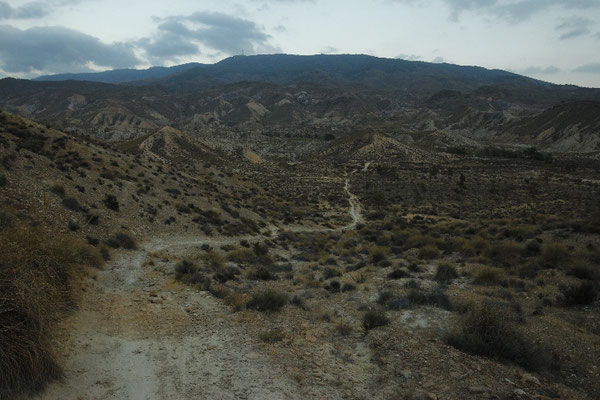
There are various hiking trails that constantly reveal new, endlessly captivating views of the beautifully sculpted landscape of the Andalusian steppe. The soil
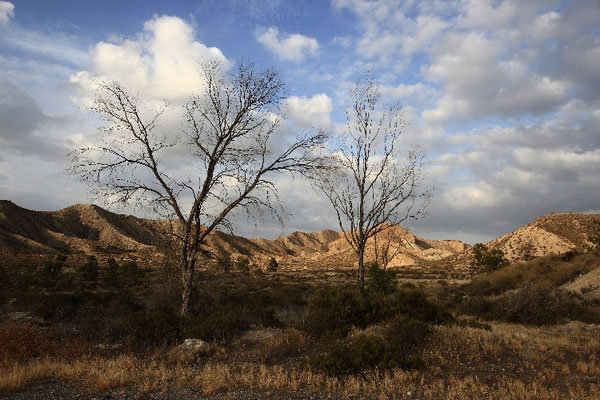
is crumbly, yet the wasteland looks like a mysterious painting. “I keep thinking that this is just a canvas,” my best friend says into the silence. There is nothing to be heard apart from the
wind. Not even goats. After only a few steps into the desert I dig my water bottle out of my backpack, as if I’d been traveling through the Sahara for two weeks. I gaze at the
thorny bushes, the black beetle on the ground, and the golden blades of grass on the hilltops.
The evening light bathes the Tabernas Desert in a mysterious glow, casting deep, long shadows and allowing the earth to cool slowly. In addition to nature, you can also visit the
sets of Western villages here, some of which appear in films like “Once Upon a Time in the West” or “Lawrence of Arabia.” Of course, the villages are man-made, and some have
taken on the character of theme parks and charge hefty admission fees. Since I’m not particularly keen on such attractions, we’ll save the 22 euros for that Wild West-Jurassic
nonsense and instead sit down on a few rocks in the middle of the desert to enjoy the sunset. The silver crescent of the moon hangs over leafless trees, while the stones on the ground glow pink.

5. Alcaidesa Beach

But enough about rocks! After all, Andalusia’s natural wonders also include the sea—in fact, two of them. First, the Atlantic Ocean near Cádiz, and second, the Mediterranean Sea near Marbella, Málaga, and Almería. Unfortunately, especially along the tourist towns, the beaches are often overwhelmingly crowded in the summer. And by that I mean a mass amount of umbrellas so dense you can’t even see the sand anymore. Plus, many places are marred by ugly hotel buildings, and bars.
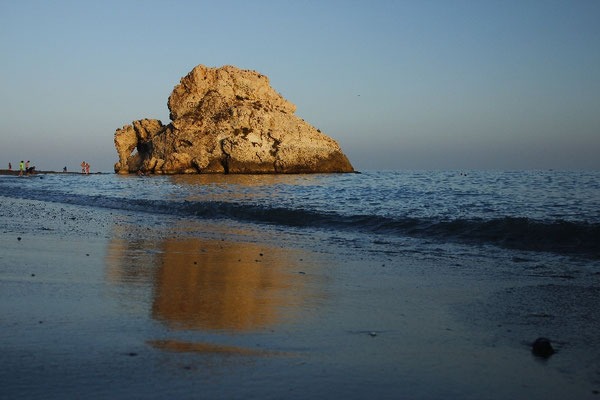
Still, there are a few natural beaches and secluded paradises that I can’t—and don’t want to—list in detail here. I’d just like to name one beach: Playa de la Alcaidesa near Algeciras. Not only is it almost a mile long and 200 feet wide, but it also offers a magnificent view of the Rock of Gibraltar, which seems to be sinking into the water like a stoney Titanic. The sand is dark gray, and the entire area is surrounded by tall cliffs lined with palm trees. Even in the afternoon during peak season, the crowds thin out nicely.

Funnily enough, you have to pass a guardhouse with a barrier at the entrance, since the beach belongs to the posh La Alcaidesa neighborhood. But there’s no admission fee, special
permits, or parking fees, which is why the job of the guy in the guardhouse seemed a bit pointless to us. He’d probably rather be lying on the beach than watching people drive in and out all
day.
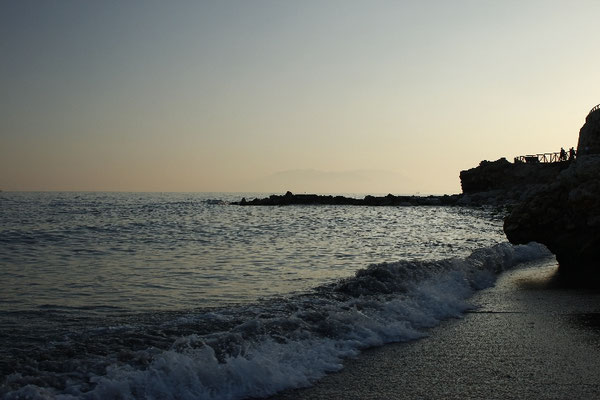
We actually manage to get up super early and visit the beach at sunrise. What a sight! The sky seems to be bathed in red, pink, violet, blue, and yellow hues, and we plop down on
a rock like in a Caspar David Friedrich oil painting and gaze into the distance.
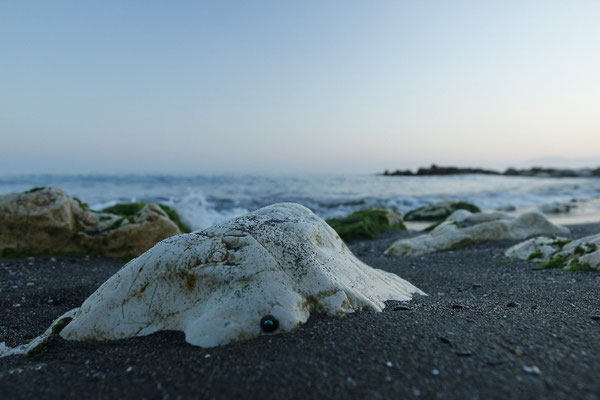
If you’re lucky, you’ll find big, brown shells in the sand. The beahc also has also restrooms and showers. However, you should bring a sun shade, because there’s no shade
on the entire beach. We found Playa de la Alcaidesa so incredibly beautiful, the we even drove back there on a whim for sunset although we were already 50 miles away. And now go and find
your own favorite spot in Andalusia's beauiful, diverse nature!
If you like, you can follow my stories and outdoor adventures daily on Instagram: @squirrel.sarah.
Find more about my trip(s) to Spain here: