
Alpenglow and the fluffiest Wildlife on Earth: Trekking in the Grand Tetons.

September 6, 2025
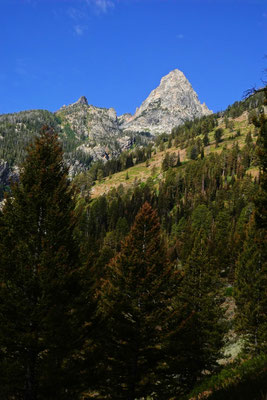
Everything is covered in dust. Absolutely everything. And because I'm sweating like a horse, the dust sticks to me like a camouflage layer. My backpack: gray, my shoes: gray, my arms: gray, the mountain wall: gray. Or in other words: I'm dying while being literally invisible. But I'm also at the top. At one of the quiet, high alpine lakes in Grand Teton National Park in the USA. With my backpack, tent, and hubby. He's dusty too. And not because he's so old.
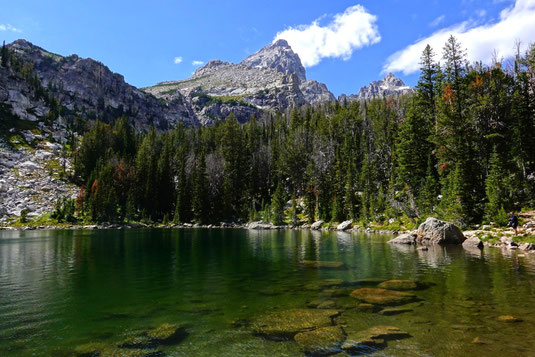
We have covered five miles and over 3000 feet of elevation gain on hot, sunny switchbacks to get to a green patch of water, round-shaped like a coin, nestled in a basin of
glacial stones, the rugged peaks of the Teton Range as a backdrop. Or in other words: it's phantasmagorically awesome.
What I don't know at the time is that it gets even better. Behind the lake lurks the gaping “Nothing” from Michael Ende's “The Neverending Story,” and the next morning everything
is made of gold. But the best thing: We see a very rare, endangered little animal that lives exclusively at altitudes between 8000 and 13000 feet. A critter that is
fluffier than squirrels (yes, you read that right!), baby cats, and ducklings. It is the ultimate embodiment of fluffiness, probably invented it, screwd it
together, and had it listed as a UNESCO World Heritage. It looks like a mixture of a mouse, a rabbit, and a squirrel, and I never thought I would see it live and right in front of my me in
my lifetime—in a place high up in the mountains at twilight and with a bouquet of flowers in its mouth. Come along and discover the magic!
A room on the 886th floor – Camping in the Grand Tetons
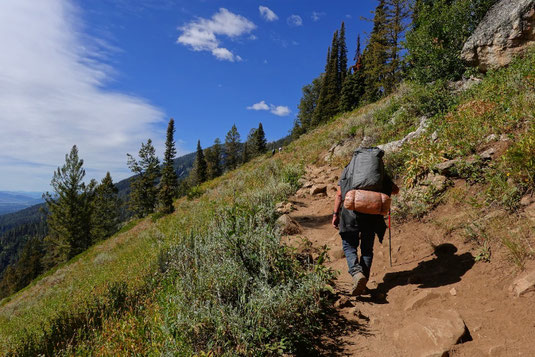
We've been on this trek twice before. Both times I cursed it. It's steeper
than a your monthly electricity bill, dustier than no spring cleaning for thirty years, and sunnier than the Negev Desert. But at the top, after all the hard work, there are
two beautiful mountain lakes, so clear, so green, so blue, so wow. Hardly anyone else is here—because only few people are crazy enough to hike up here—and they are surrounded by
steep stone walls, as if you were sitting in a Greek amphitheater waiting for Sisyphus to descend.
Like last time, we got a backcountry permit from the National Park Service, brought our tent, and throw it right here exhausted into the dust. So it's gray now, too.
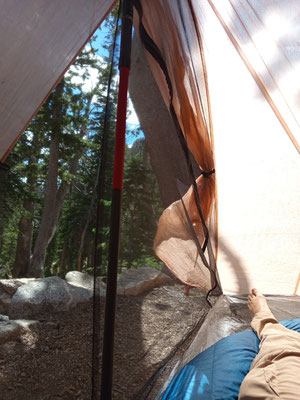
Once camp is set, we lie down inside of the tent. Amazing—and a badly needed rest. Outside, the bark of the many pine trees smells from the sunshine and warmth, even though the temperatures up here are significantly cooler than in the valley. Our camp sits at 9500 feet elevation. It's like having an apartment on the 886th floor. A light wind rustles in the treetops, white clouds drift across the sky. Every now and then, a ground squirrel scurries by. Right next to our tent is a thick tree with several cave entrances and skeletons of plundered pine cones. I bring my hiking boots inside the tent. I love squirrels, but squirrels love shoes and hiking sticks and like to nibble on them at night. A wildlife autograph I'm not so keen on.
Ground Squirrels, the big "Nothing", and a Mountain Cathedral
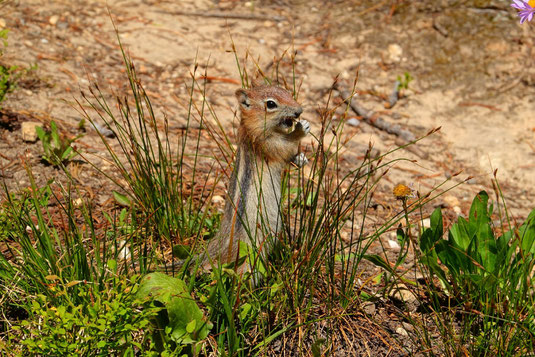
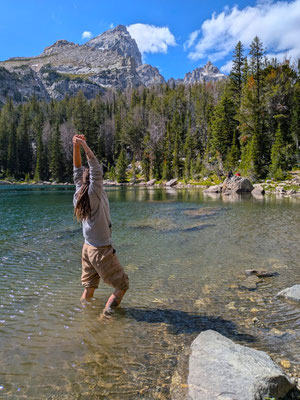
Towards evening, we wander down to the lower lake. The one that looks like a green coin. My goodness, it's so clear! You can see every single stone on the bottom! There's also a golden-mantled ground squirrel hopping around, pulling grasses toward it like a scent sample, clearly aware of its modeling skills. But I don't give it any crumbs, because I follow the “keep wildlife wild” line. Feeding wild animals can lead to fatal gastrointestinal problems, spread disease, cause animals to forget how to find enough food on their own (in months when there are no tourists), and make them so accustomed to humans that they sometimes become aggressive and have to be killed by rangers. I wouldn't want to do any of that to any ground squirrel in the world just because my human brain goes from “That's cute!” to “I want to feed it!”
On our walk around the lake, we also discover the place where the lake flows out. Most lakes have an inlet and an outlet.
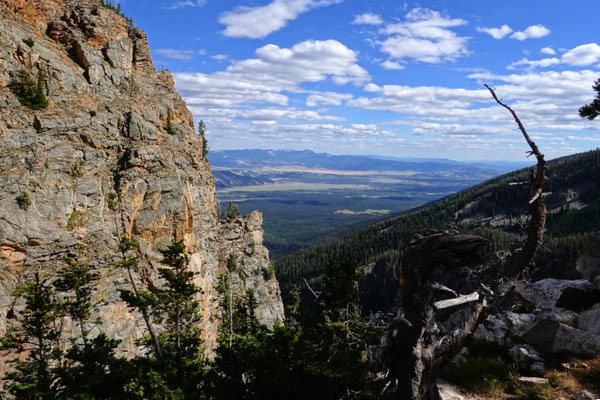
Curiously, I lean over the edge and almost faint. But luckily I don't, otherwise I would have fallen several hundred feet deep. Behind the lakeshore there is absolutely nothing. Just steep scree and, far below, the valley. Whooaat! I have to hold on to a dead tree stomp so I don't accidentally get dizzy or blown away by the wind. Crazy shit!
On the other side are huge stones—gray, by the way—that look as if a giant had grown tired of playing dice and just thrown them down the hill. There they lie on the green
mountainside, ranging in size from small chairs to SUVs (actually moving glaciers from the last ice age placed them there but I like giants better).
As we climb a little higher, we come across the second lake. It is not round and green, but oval and blue. And it is surrounded almost 360° by incredibly
high mountain slopes. Every step echoes and I instantly feel like I'm in a Gothic cathedral. It is now much cooler, the sun having disappeared behind the cathedral walls. I feel tiny in
this huge place, my life a millisecond in the history of the earth. And then I hear the small, shrill cries.


A magical encounter: Pikas in the alpine Zone
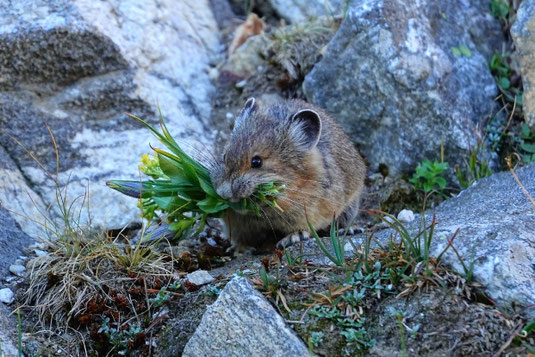
At first, I can't identify the sound, but then its source almost runs over my foot: Pikas! Small, mouse-like fluffy balls that are threatened with extinction due to climate change. Pikas are extremely sensitive to temperature and can die after only being exposed briefly to temperatures around 75°F. Today, even up here, it's 71°F – and hot days like there are no longer an exception. In addition, there is less and less snow in winter, which they need as an insulating layer against frost in their burrows. Less snow also means less drinking water in summer. Since I learned how endangered this little animal is and how high up its habitat is, I had little hope of ever seeing it live in my lifetime. But here it is, and I want to cry with joy. I hold my breath and just watch it. Barely bigger than my fist, tiny round ears, small paws. The pika's closest relative is the rabbit.
While I'm still watching and trying to operate my stupid camera as inconspicuously as possible with my excited, trembling hands, the pika plucks tufts of grass and flowers. Then it stuffs its find into its mouth and dashes off. It looks like a bouquet for a wedding. This animal cannot go extinct! It is the epitome of fluffiness. Please let there be hope in a world where such miracles exist.
Of course, pikas don't collect these bouquets for decoration, but rather to create underground “haystacks” (yes, that's the official term) to help them survive the winter when nothing else is growing.


Alpenglow and mirror lakes in the Grand Tetons
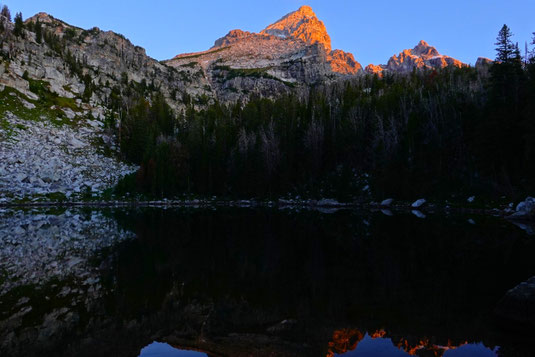
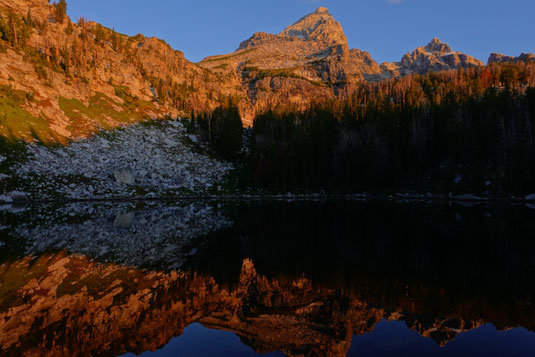
After a quiet night under the stars, the mountain peaks begin to glow with sunrise. Nothing is dusty and gray anymore—everything is on fire. I run down the path from the campsite to coin-shaped lake. The water surface is smooth and glassy as a mirror. And with every second, more gold from the morning sun drips over the mountains and slopes. An experience we were already able to share one other time up here four years ago. But this time it's even more intense. There isn't enough storage space on my camera or in my brain to really process this moment. The only things that remain stuck in this kaleidoscope of orange, turquoise, and blue are puzzle pieces of “Ah!” and “Uh!”
We eat our breakfast—dehydrated omelette, revitalised with filtered lake water, heated on our small gas stove—at the upper lake, in the "cathedral". For a moment, it seems as if the entire lake has disappeared overnight. The reflection is so perfect that you have to look several times to see the boundary between water and land. In the background, we hear the shrill cries of the pikas, which we are actually able to spot and marvel at again. I am in heaven! We sit by the lake for a long time, completely alone, before a few mountaineers descend from a nighttime summit attempt on Grand Teton. Every moment I spend in the wilderness brings me closer to nature, refines connections, leads me to inner peace, to curiosity, and to the desire to spend even more time out here.
If you like, you can follow our adventures, hikes, and experiences daily on Instagram: @squirrel.sarah.
Find more hiking and mountain adventures here:
- Northern Lights, Dog Sledding, and cold Feet at World's End - Alaska in Winter
- Hiking in Luxembourg: Gorges, Waterfalls and Awe in the Mullerthal
- Icy Fire on the Matterhorn and Dream Trip Glacier Express– Road trip Switzerland II
- The Reflection of the World in the Grand Tetons: 3 Days, 3 Lakes, 11 Miles


