
Turquoise Trail New Mexico: Wind Chimes, Jewelry and Hippie Vibes.
Road Trip · Turquoise Trail · New Mexico, USA · 65 Miles · Day Trip

January 26, 2018 / Update: March 28, 2026
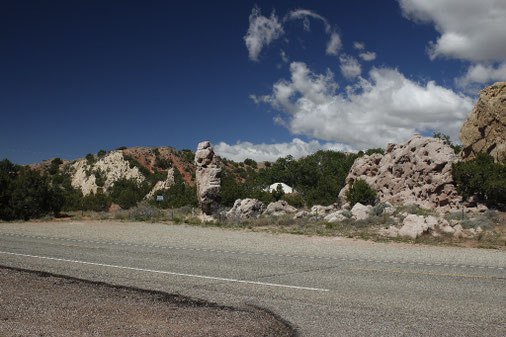
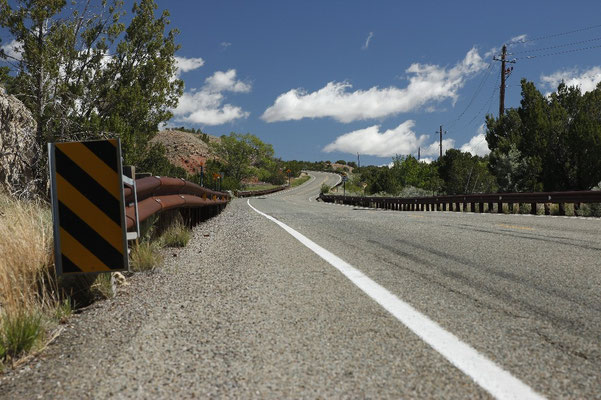
Colorful wind chimes tinkle softly in the breeze. The sky stretches across the horizon like a vast blue canvas. Rugged cliffs cast jagged shadows on the peeling asphalt. This is where a beautiful road winds its way for about 65 miles. This is the Turquoise Trail in New Mexico, USA. A road that leads through an enchanting landscape of red rocks and sandy scrubland and runs between Santa Fe and Albuquerque. Along the route, you’ll find small museums, artisanal crafts, and plenty of fascinating turquoise treasures! This is not a quick drive from one place to another on the interstate, this is a true slow summer's day road trip.
You can start your journey on the Turquoise Trail at either end: in Santa Fe or in Albuquerque. The views of course are different depending on which direction you drive, but
it’s simply beautiful either way, no missing out no matter what you do, and no recommendation at this point.
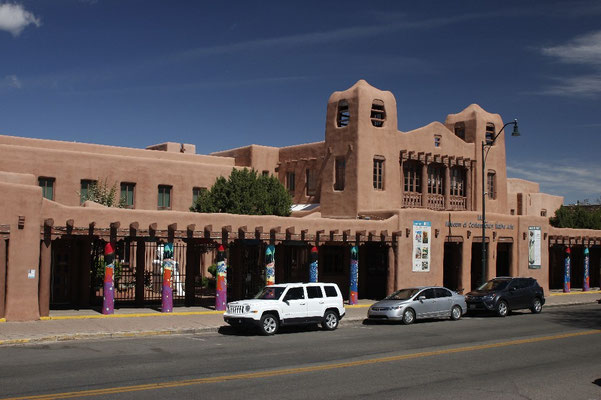
I started my road trip in Santa Fe. This city is over 400 years old and resembles a gem crafted from orange adobe. For me, Santa Fe is definitely one of the most unique
places in the world. Although it’s the capital of the State of New Mexico with over 90,000 residents, it feels like a small town, as if the entire city were just one charming
historic district. This feeling stems in part from the fact that most of the houses were built in the warm, brown Pueblo Revival style. In 1912, the city decreed that all new buildings
must henceforth be constructed in this style. Even in the 21st century, the town continues to require adherence to this style in the downtown area. Come with me on a journey where the clocks stop
and magic begins!
Get started on the Turquoise Trail in New Mexico
From Santa Fe, the Turquoise Trail leads out of town on Highway 14. The road is open year-round, and signposted as a “Scenic Byway”. However, I sometimes have trouble spotting signs while driving without accidentally hitting them, so I simply enter Los Cerrillos as my first destination in my GPS. This will automatically take you onto the Turquoise Trail. Just past Santa Fe, the flat steppe with its gray-green grasses stretches toward an endless horizon. White clouds lie over the landscape as if they were pressed onto a sheet of glass.
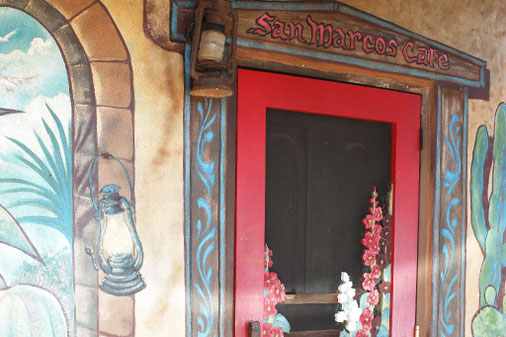
You can make your first stop at the San Marcos Cafe & Feed Store. Painted flowers entwine the colorful wooden door. As I arrice a gentle breeze stirs up a red plume of dust in the air. If you haven’t stocked up yet or look for a special souvenir: Here you’ll find, among other things, a great paper map of the Turquoise Trail, and cinnamon rolls. You’ll also find gas stations along the way. However, it’s more relaxed and cheaper to fill up in Santa Fe or Albuquerque. The journey continues to Los Cerrillos. The mining area there is one of the oldest in the entire U.S.
Madrid, New Mexico: From Ghost Town to Art Town
The word “mine” always makes me think of hard work, coal and steel. But here, turquoise was mined. The first stones were extracted by Pueblo tribes around 900
AD. Today, along the trail, you’ll find small jewelry shops in almost every village where turquoise—ranging from the deepest blue to the lightest green—is sometimes
still crafted on-site by local artists. In Los Cerrillos, you can learn more about the history of this watercolor-hued mineral at the Mining Museum.
The next stop is my favorite place on the Turquoise Trail: the village of Madrid. After its heydays, the town literally crumbled to dust with the end of mining
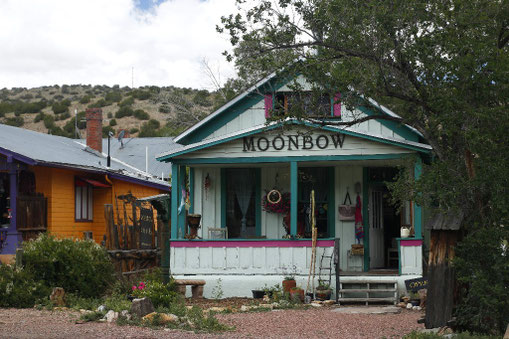
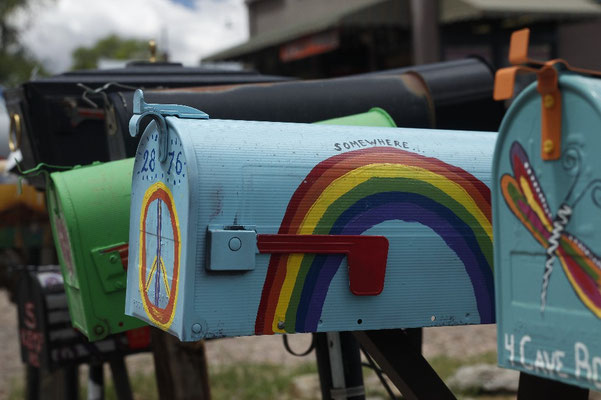
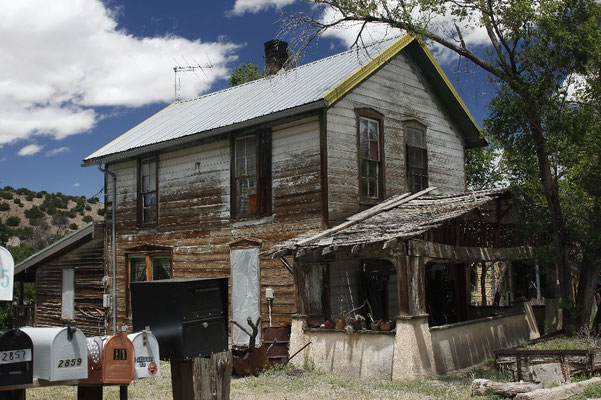
and fell into ruin as a ghost town. This is hard to imagine as I drive past colorful pottery shops, art galleries, tinkling wind chimes, and rainbow-colored
mailboxes. That's because hippies and artists brought the ruins back to life in the 1970s. Today there are amazing places like the Jezebel Gallery with a ton of incredibly
delicious ice cream or the Indigo Gallery with its whole strange and
beautiful universe of orange rocks and bronze sheep—sculptures and paintings. All people here are friendly and love to talk about their art and life on the Turquoise Trail. You should plan on
spending at least two hours in Madrid, even though it basically consists of just a single street—which is, however, downright magical.

Breathtaking Views on Turquoise Trail and the Last Church in Town
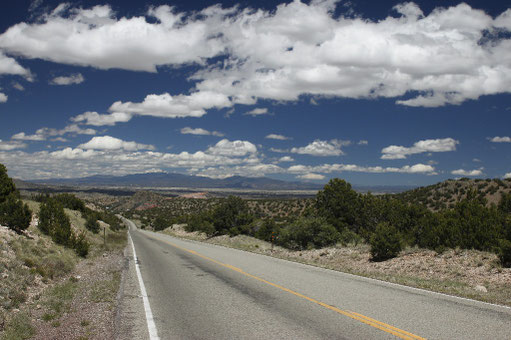
Leaving Madrid behind, the highway winds its way up the rust-brown mountains; your breath catches and gets caught in the thorns of the cacti lining the road as you glance in the rearview mirror. Be sure to pull into one of the many pull-outs, touch the warm asphalt, and let the endless array of colors wash over you.
Shortly after, you’ll reach Golden. But the name is misleading. The town lies in ruins. Only the picturesque San Francisco Catholic Church still stands.
Near San Antonio, take a detour onto Highway 536 toward Sandia Park and the Sandia Crest mountain peak. In summer, you can hike here, and in winter, you can ski. In any season, the view from the Sandia Mountains down to Albuquerque is worth seeing—especially at sunset. The highest point is at 10,500 feet. You can drive to the summit on a 12-mile-long, winding but well-maintained mountain road.
Wonderland Tinkertown Museum
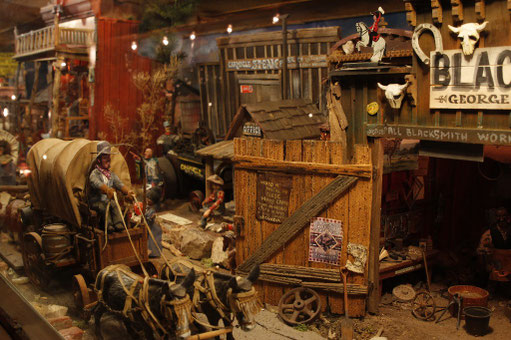
Further down the valley, there’s another really quirky little museum waiting for you: the Tinkertown Museum (closed in winter). Here old Western towns come to life in lovingly crafted miniature worlds, and hundreds of handcrafted wooden figures begin to creak and move their historic limbs as soon as you drop in a quarter. A fairy-tale place not just for kids!
By the way, I saw the first hummingbird of my life at a small feeding bowl next to the entrance. I was soo excited!
The last stop on the Turquoise Trail is Tijeras. Around 500 people live here, and there’s a visitor center for hikes in the Cibola Forest. You’ll also come across a section of historic Route 66 if you drive from there toward Albuquerque.
Turquoise Trail: Lenght, Climate and Lodging

The Turquoise Trail itself is 65 miles long and can be covered in a single day with a few stops. If you want to spend more time exploring the many galleries and shops, you should plan on two days—there are several bed-and-breakfasts and campgrounds available. However, the B&Bs along the roads are much more pricey than in Santa Fe or Albuquerue. It’s also worth setting aside an extra one or two full days to explore both cities. By the way, the route is also suitable for RVs.
During the summer months, the Turquoise Trail can get very dry and hot, while in winter there can be snow and frost. I therefore recommend fall and spring for this road trip.
Have you already been there yourself? Then feel free to drop a comment about your own experiences, impressions, and favorite spots!
If you like, you can follow my stories, travels and outdoor adventures daily on Instagram: @squirrel.sarah.
Find more about New Mexico and roadtrip adventures I have been on:
Kommentar schreiben